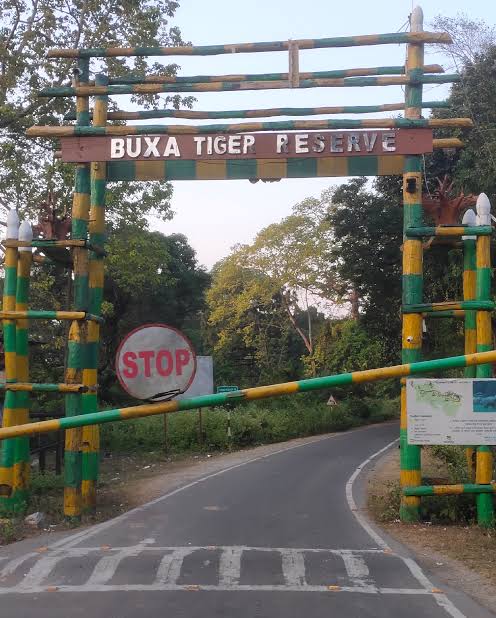
Spread across the eastern Dooars and stretching toward the Bhutan border, Buxa Tiger Reserve stands as one of North Bengal’s most ecologically significant landscapes. Established under Project Tiger in 1983, it became India’s 15th tiger reserve — a distinction that today spans nearly 758 sq. km of critical tiger habitat and buffer forest.
But Buxa’s importance extends well beyond its name. The reserve forms a vital ecological corridor linking the landscapes of Bhutan, West Bengal and Assam, and it shelters a striking range of biodiversity: 68 mammal species, 246 bird species, 41 reptile species, four amphibian species, and more than 100 species of fish. Its terrain shifts from riverine and sal forests to semi-evergreen, evergreen, hill and savannah tracts — a mosaic of habitats supporting some of the region’s most valuable wildlife, including elephants, leopards, clouded leopards, gaur, deer and wild dogs.
Historically, Buxa has also been associated with the Royal Bengal Tiger. Yet for decades, a stable tiger population has eluded the reserve. National assessments have repeatedly recorded Buxa without a resident tiger population, even as the landscape continued to hold suitable habitat and prey potential.
That may now be changing.
A New Beginning for Buxa
West Bengal is preparing to undertake one of its most ambitious wildlife conservation efforts in North Bengal: the reintroduction of tigers into Buxa Tiger Reserve.
The initiative is not conceived as a single act of releasing an animal into the wild. Its larger purpose is to rebuild a self-sustaining tiger population in a landscape that historically supported the species. Carried out under the guidelines of the National Tiger Conservation Authority (NTCA), the programme involves habitat preparation, prey-base assessment, strengthened protection measures, scientific monitoring, and the long-term development of conditions under which released tigers can establish themselves.
The first major breakthrough came this week, with Bihar clearing the transfer of several tigers to West Bengal. According to current reports, the first animal to be moved is likely to be a tigress from Valmiki Tiger Reserve, with authorities considering an airlift to complete the transfer.
West Bengal has set October 2, 2026 as the target date for releasing a tiger into Buxa — a milestone being positioned not as an isolated event, but as the starting point of a sustained, long-term conservation programme.
Preparing the Forest
Habitat preparation forms one of the most demanding aspects of the project. Successfully reintroducing tigers requires far more than simply releasing animals into a reserve: it demands adequate territory, a reliable prey base, water availability, protection from human disturbance, and a landscape that allows natural movement and territorial establishment. As a result, managing human settlement within the reserve has become a central part of the preparatory work.
In a significant development, more than 300 families from Jainti — one of the largest forest villages within Buxa — have agreed to relocate voluntarily. Their move is expected to open up a larger, undisturbed landscape for wildlife and support the broader habitat restoration effort.
The challenge, however, extends beyond relocation alone. Long-term conservation success depends on keeping forest-dependent communities engaged as active participants rather than displaced bystanders. Balancing wildlife protection with the livelihood and rehabilitation needs of these communities is likely to remain one of the project’s most persistent challenges.
More Than Bringing Back a Tiger
The implications of this reintroduction reach beyond the return of a single iconic species.
As an apex predator, the tiger plays a defining role in forest ecosystem dynamics. A successful, self-sustaining population could help strengthen the ecological balance of Buxa and reinforce its standing as a significant wildlife landscape in the eastern Himalayan foothills.
Buxa’s geography adds further weight to the project. Positioned along the Bhutan border and forming part of a larger transboundary landscape, with its eastern edge connecting toward Assam, the reserve already functions as an important corridor for elephant movement between India and Bhutan. Strengthened protection and habitat restoration in Buxa, therefore, stand to benefit wildlife conservation well beyond the tiger alone.
At the same time, the programme will be watched closely, given how complex tiger reintroduction efforts can be. Its ultimate success will hinge on factors including prey availability, territorial space, genetic diversity, human-wildlife interaction, and sustained scientific monitoring over the years ahead.
For Buxa, October 2 is more than a date on the calendar — it could mark the opening of a new chapter in the reserve’s conservation history.
For decades, Buxa’s forests have continued to thrive as one of North Bengal’s richest ecosystems. As preparations move forward to bring the tiger back, the real test will begin only after the release: whether this landscape can once again become a place where tigers do not merely survive, but establish and sustain a population of their own.
Perhaps, after years of waiting, the forests of Buxa may finally hear the roar they have been missing.
Moli Biswas
BMS Dept – 2nd Year